Have you ever stared at a delicate filet crochet pattern—those elegant lace-like squares, floral motifs, or even words spelled out in mesh—and wondered, “How on earth did they make that?”
You’re not alone. Filet crochet might look like magic, but it’s actually one of the most logical and satisfying forms of crochet once you learn its language. Unlike traditional crochet that relies on dense stitches to form fabric, filet crochet uses open mesh and solid blocks to create images—like a pixelated tapestry made with yarn and a hook. Whether you want to make a christening blanket with a baby’s name, a curtain with a vine pattern, or a wall hanging that tells a story, filet crochet charts are your secret map.
In this guide, we’ll break down everything you need to know to read, understand, and create your own filet crochet charts—from decoding those tiny squares to turning your favorite designs into reality. No prior experience? No problem. We’ll start from the very beginning and build up with simple analogies, real-life examples, and step-by-step tips that make even the most intimidating patterns feel approachable. By the end, you’ll not only know how to follow a chart—you’ll be excited to design your own.
What Is Filet Crochet—and Why Should You Care?
Imagine a grid of tiny squares, like a crossword puzzle or a pixel art game. Now imagine each square isn’t filled with letters or colors, but with crochet stitches. That’s filet crochet in a nutshell.
At its core, filet crochet uses only two basic stitches: the double crochet (dc) and the chain space. Together, they form two types of “cells”:
- Solid blocks = 3 dc stitches side by side (closed square)
- Open mesh = 2 chains + 1 dc (open square)
These two elements are arranged in a grid to form pictures, letters, or abstract patterns. Think of it like embroidery—but instead of threading a needle through fabric, you’re building the fabric stitch by stitch.
Why does this matter? Because filet crochet is the perfect blend of art and logic. It lets you turn ideas into tangible art. Want a heart for Valentine’s Day? A monogram for a wedding gift? A silhouette of your favorite animal? Filet crochet can do it. And because it’s made with open spaces, it’s lightweight, breathable, and perfect for curtains, table runners, or even fashion accents.
Plus, unlike knitting or embroidery, filet crochet is easy to fix. If you make a mistake? Just unravel a few rows. The grid structure makes it simple to count back and correct. It’s forgiving—and that’s why so many crafters (from beginners to pros) fall in love with it.
And here’s the best part: you don’t need to be an artist to create beautiful designs. You just need to learn how to read the chart.
Decoding the Chart: Your New Visual Language
If you’ve ever looked at a filet crochet chart and felt like you were staring at ancient hieroglyphs—don’t worry. You’re not dumb. You just haven’t learned the code yet.
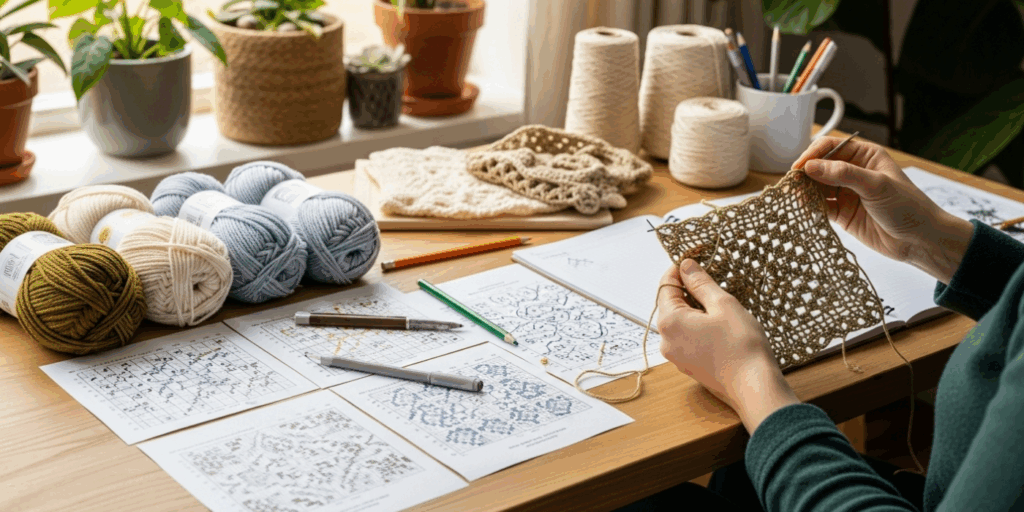
A filet crochet chart is a grid. Each square represents one “cell” in your project. The chart tells you whether each cell should be solid or open. But here’s the twist: how you interpret those squares depends on how the pattern is drawn.
There are two common styles:
- Filled squares = solid blocks (3 dc)
Empty squares = open mesh (2 ch + 1 dc) - Filled squares = open mesh
Empty squares = solid blocks
Yes, this can be confusing. Always check the legend at the top or bottom of your chart. Most modern patterns will clearly state:
“Black square = solid mesh | White square = open mesh”
If it doesn’t? Look for a key symbol or a note like “Pattern is worked from bottom to top, right to left.” That’s your clue.
Let’s make this real. Imagine you’re making a simple heart. The chart might look like this (imagine it as a grid):
1
2
3
4
5
6
□ □ ■ ■ ■ □ □
□ ■ ■ ■ ■ ■ □
■ ■ ■ ■ ■ ■ ■
■ ■ ■ ■ ■ ■ ■
□ ■ ■ ■ ■ ■ □
□ □ ■ ■ ■ □ □
In this case, ■ = solid, □ = open. You’d start at the bottom row, work right to left, and each row builds upward. One row = one horizontal line of your design.
Pro tip: Always count your stitches. If a row says “7 cells,” you should have 7 blocks. Each solid block = 3 dc + 1 chain between (except the last one). Each open block = 2 chains + 1 dc. So for a 7-cell row, you’ll need:
- Start with 4 chains (counts as first dc + 1 chain)
- Then: (dc, ch 1) for each solid block
- (ch 2, dc) for each open block
- End with a dc at the final cell
It sounds complex, but after two rows, it becomes second nature. Think of it like learning to read music—you don’t memorize every note at first. You just start playing.
Turning Images Into Charts: Your First Design Project
Here’s where the magic happens: you can turn almost anything into a filet crochet chart.
Want to crochet your dog’s face? Your favorite quote? A Christmas tree? All you need is a simple image and a little patience.
Start by choosing a simple, high-contrast image. A silhouette works best. For example:
- A candle
- A star
- The word “LOVE” in block letters
Use free online tools like Pixelastic, Image to Crochet Converter, or even Excel/Google Sheets to manually convert your image into a grid. Here’s how:
- Resize your image to 20–30 pixels wide (smaller = easier for beginners).
- Convert it to black and white using any photo editor.
- Print it out and color in the solid areas with a marker.
- Transfer it to graph paper—each square = one cell.
Now you have your custom chart!
Let’s say you want to crochet “HELLO” in block letters. Each letter is about 5 cells wide. You’d sketch each letter on graph paper, filling in the squares that should be solid. Then, count how many rows each letter takes. Write down the sequence:
Row 1: H = [open, solid, solid, solid, open]
Row 2: H = [solid, solid, solid, solid, solid]
… and so on.
You can even use color-coded charts. Want to add a border? Use a different color pen for the outline. Want to make a background? Fill in the outer squares lightly.
This isn’t just crafty—it’s empowering. You’re no longer limited to patterns someone else made. You’re the artist. And the best part? Once you make one chart, you can reuse the system for anything: baby onesies, tote bags, even pillow covers.
Try this: Next time you see a logo you love—a coffee shop emblem, a band logo, a family crest—grab graph paper and try to recreate it. You’ll be amazed at how quickly your eye starts seeing patterns everywhere.
Common Mistakes (And How to Avoid Them)
Even the most experienced crocheters mess up filet charts—especially when they’re tired or distracted. Here are the top three mistakes—and how to dodge them.
Mistake #1: Misreading the Starting Chain
Many beginners think the first chain counts as a stitch. It doesn’t. In filet crochet, the first 4 chains usually count as your first dc + 1 chain. So if your row starts with a solid block, you’re already halfway there. If you chain 5 instead of 4, your pattern will shift and look crooked.
✅ Fix: Always check the pattern’s starting instructions. Write “Ch 4 = dc + ch” on your chart.
Mistake #2: Losing Your Place in the Grid
Filet crochet looks repetitive. One row of open mesh looks just like the next. It’s easy to lose track—especially if you get interrupted.
✅ Fix: Use a highlighter or sticky note to mark your current row. Or better yet, number your rows as you go. Write “Row 1,” “Row 2,” etc., in the margin of your chart. It’s like a progress tracker—and it prevents panic when you’re halfway through a 50-row blanket.
Mistake #3: Ignoring Tension
Because filet crochet has so many open spaces, it’s tempting to pull your stitches too tight. But if your chains are too tight, your design will warp. Too loose? Your mesh looks sloppy.
✅ Fix: Practice on a small swatch first. Aim for consistency. If your open mesh looks like it’s sinking, your tension is too tight. If it’s flaring out, you’re too loose. Find your sweet spot—and stick with it.
Bonus tip: Work in good lighting. Filet crochet is all about counting. If you can’t see the holes clearly, you’ll miscount. A daylight lamp or a phone flashlight makes all the difference.
Creating Your Own Patterns: From Idea to Reality
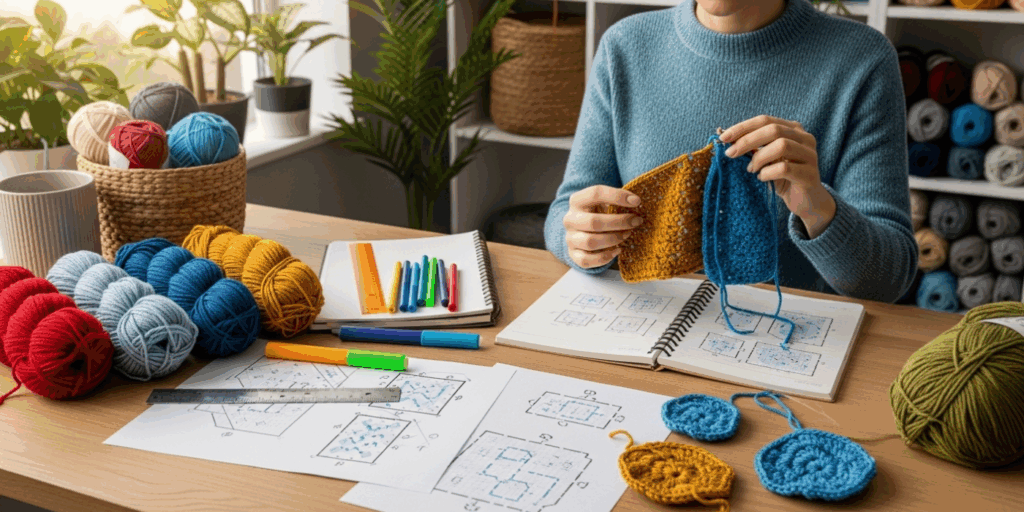
You’ve learned to read charts. You’ve avoided the pitfalls. Now it’s time to create something entirely your own.
Let’s say you want to make a birthday table runner with a cake and candles. Here’s your step-by-step plan:
- Sketch your idea on paper: a simple cake with 3 candles. Keep it minimal—no shading, no details.
- Transfer it to graph paper. Each square = 1 stitch.
- Decide your size. A 10-inch runner? That’s about 40 cells wide.
- Add a border. Use solid blocks around the edges to frame your design.
- Write your row-by-row instructions.
- Row 1: All open mesh (base)
- Rows 2–8: Build the cake layers (solid blocks)
- Rows 9–12: Add candles (thin vertical solids)
- Rows 13–15: Fill in the frosting (curved tops)
- Test it with yarn. Crochet the first 10 rows. Does it look right? Adjust if needed.
This isn’t just crafting. It’s problem-solving. You’re translating imagination into structure. And that’s deeply satisfying.
Want to go further? Try color changes. Use a contrasting yarn for your design against a neutral background. Or add embroidery after crocheting—stitch a name in black thread over your mesh. The possibilities are endless.
And here’s a secret: many commercial filet patterns are just someone else’s original design. You’re not copying—you’re continuing a tradition of handmade storytelling.
Why Filet Crochet Feels Like More Than Just a Craft
There’s something deeply human about filet crochet.
In a world of instant gratification—where we swipe, tap, and scroll—filet crochet asks you to slow down. To count. To pay attention. To sit with your hands and your thoughts.
It’s meditative. It’s nostalgic. It connects you to generations of women who stitched family crests, wedding linens, and church altar cloths—not because they had to, but because they wanted to leave something beautiful behind.
When you make a filet piece, you’re not just making a blanket. You’re making a memory. A gift that says, “I spent hours on this—for you.”
I once met a grandmother who crocheted a filet curtain for her granddaughter’s nursery. Each row held a letter of the baby’s name. She worked on it for six months, only stitching while listening to lullabies on repeat. When she gave it to her daughter, she said, “I didn’t just make fabric. I made peace.”
That’s the power of filet crochet.
It doesn’t need to be perfect. It just needs to be yours.
Ready to Start? Here’s Your First Challenge
You’ve learned how to read charts. You’ve seen how to create them. You know the common mistakes—and how to avoid them.
Now it’s your turn.
Your mission (should you choose to accept it):
Grab a piece of graph paper. Pick one word—your name, your favorite quote, or even “HOME.”
Draw it in block letters, 5 cells tall.
Turn it into a filet chart.
Then, pick up your hook and yarn, and crochet the first 5 rows.
You don’t need to finish it today. Just start.
And when you do? I’d love to hear what you made.
👉 Leave a comment below: What’s the first word or design you’re going to crochet? Share your idea—or even a photo of your first row. Let’s build a community of filet lovers, one stitch at a time.
And if you found this guide helpful? Share it with a friend who loves crafts, gifts, or quiet moments with yarn and a hook. Because beauty shouldn’t be kept to ourselves.
You’ve got the map. Now go make something that only you could have created.
Happy crocheting. 🧶✨
Gabriela Ferreira is a passionate crochet and knitting enthusiast who finds inspiration in every skein of yarn she touches. With a love for color, texture, and handmade detail, she brings creativity and warmth to each project she creates. Gabriela believes that every stitch tells a story, and she enjoys sharing her craft with others who appreciate the beauty of fiber arts.