Introduction
You’ve just finished your latest creation—a buttery-soft baby blanket edged with delicate picots, or maybe a bold boho market tote with handmade tassels. You step back, heart full, and think: “I could sell this.”
But where? Should you snap a few photos and list it on Etsy? Or pack up your car and set up a booth at the weekend farmers’ market?
Choosing between online marketplaces like Etsy and in-person local markets is one of the first big decisions handmade sellers face—and it’s not just about “where to sell.” It’s about your personality, goals, time, and what kind of creative business you want to build.
In this article, we’ll break down the real-world pros and cons of selling crochet on Etsy versus at local craft fairs, pop-ups, or community markets. You’ll discover how each option affects your time, profit, customer connection, and even your design process. Plus, we’ll share practical tips to help you decide—or even combine both—in a way that feels sustainable and joyful.
Because your crochet isn’t just a product—it’s a piece of your heart. And it deserves to find its home in a way that honors both your craft and your life.
Let’s explore which path might be your perfect fit.
The Allure of Etsy: Global Reach, 24/7 Storefront
For many crocheters, Etsy feels like a dream come true: a ready-made online shop that connects you with buyers worldwide, all from your living room.
And there’s real magic in that. With over 95 million active buyers (as of 2024), Etsy offers access to a massive audience who specifically seek handmade, vintage, and unique goods. Your boho crochet earrings could end up in Portland, Paris, or Perth—all while you’re sleeping.
Key advantages of selling on Etsy include:
- Low startup cost: No need for a physical booth, tablecloths, or signage—just great photos and clear listings.
- Passive income potential: Once your shop is live, sales can happen anytime, even when you’re not “working.”
- Search-driven traffic: Buyers come to Etsy looking for crochet baby hats, amigurumi, or market bags—so if you optimize your listings, they’ll find you.
- Easy to scale: You can list 5 items or 500. Duplicate bestsellers with ease using templates and saved photos.
Real-Life Win: Maya, a stay-at-home mom in Ohio, started selling crochet hair scrunchies on Etsy during nap time. Within six months, she was earning enough to cover her kids’ extracurricular fees—all without leaving the house.
But it’s not all seamless. Etsy demands strong photography, keyword-savvy titles, and consistent customer service. And with over 5 million active sellers, standing out requires strategy—not just stitches.
The Charm of Local Markets: Connection, Instant Feedback, and Community
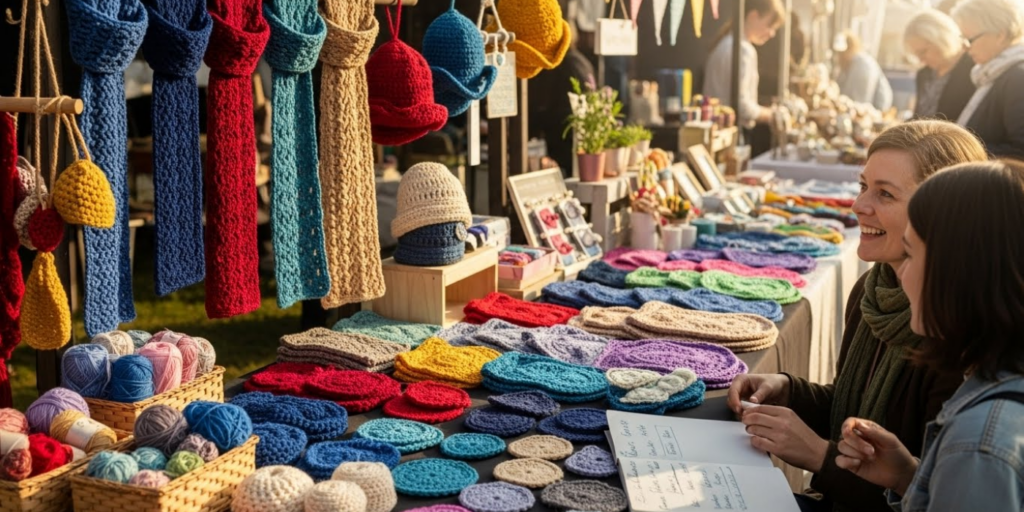
Now imagine this: You’re under a white canopy on a sunny Saturday morning. A little girl tugs her mom’s sleeve and points to your display of amigurumi animals. “Can I hold the bunny?” she asks. You hand it to her, smiling as her eyes light up. Ten minutes later, they walk away with three stuffed friends—and you’ve made a real human connection.
That’s the power of local markets.
Whether it’s a holiday craft fair, a summer street market, or a monthly makers’ pop-up, in-person selling offers something Etsy never can: face-to-face interaction. You see exactly what makes customers pause, smile, or reach for their wallet. You get instant feedback (“Do you make this in blue?”) that can spark your next bestseller.
Why local markets shine:
- Immediate sales: Cash in hand, no waiting for shipping or PayPal clearance.
- Brand building: People remember you, not just your product. Your story becomes part of your brand.
- Zero algorithm stress: No need to “game” search rankings—your display and charm do the work.
- Community support: Fellow vendors often become collaborators, referral sources, or even friends.
Pro Tip: Bring a small sign that says “Custom Orders Welcome!” Many customers will ask for personalized pieces on the spot—great for higher-value sales.
That said, local selling comes with real costs: booth fees ($25–$200+), time prepping and packing, weather risks, and the emotional rollercoaster of a “slow” market day. It’s rewarding—but demanding.
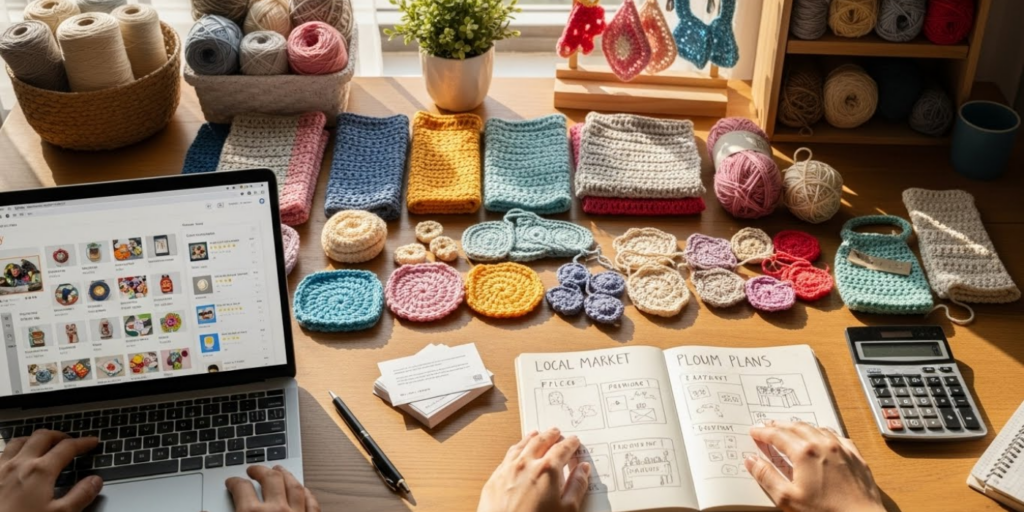
Breaking Down Costs, Time, and Profit Margins
Let’s talk numbers—because passion doesn’t pay the bills, but smart pricing does.
Etsy costs:
- Listing fee: $0.20 per item (renews every 4 months)
- Transaction fee: 6.5% of sale price
- Payment processing: ~3% + $0.25
- Shipping supplies & labels: You cover this
- Time investment: Photography, SEO, messaging, packaging, shipping
Local market costs:
- Booth fee: $30–$150 per event (sometimes more in prime locations)
- Display setup: Table, tent, signage, inventory transport
- No platform fees—but you keep 100% of sales (minus sales tax, if applicable)
- Time investment: Setup/teardown, travel, full-day presence, inventory prep
Example: Say you sell a $35 crochet market bag.
- On Etsy: After fees + $5 shipping, you net ~$25.
- At a market: You keep the full $35 (no shipping!), but you paid $50 for the booth. You’d need to sell at least 2–3 items just to break even.
Profit isn’t just about per-item margin—it’s about volume, consistency, and hidden labor. Etsy rewards systems and scalability. Local markets reward charisma and curation.
Ask yourself:
- Do you love chatting with people, or prefer quiet crafting time?
- Are you strong with tech and photos, or more tactile and visual?
- Can you afford to “lose” a slow market day, or do you need reliable income?
Your answers will point you toward your best fit.
Which Suits Your Personality and Lifestyle?
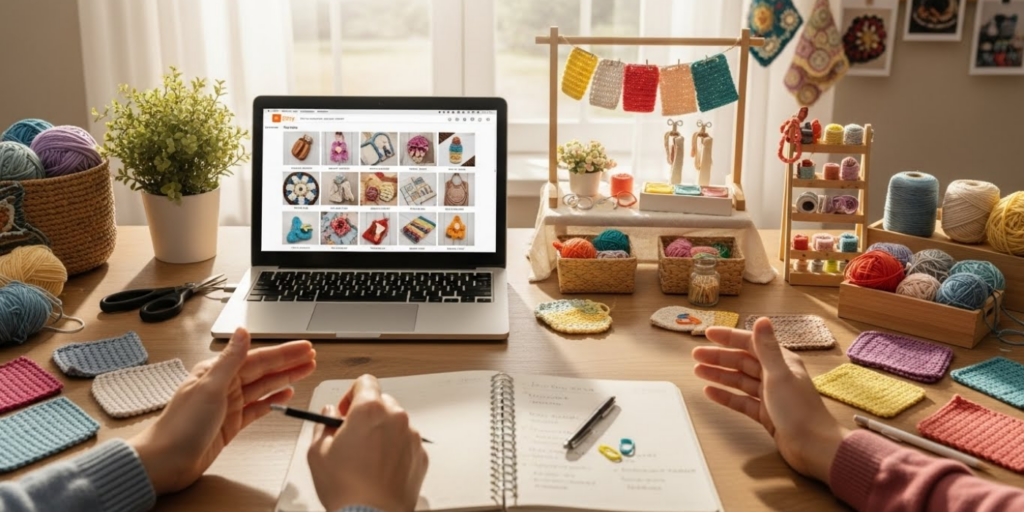
Here’s the truth no one talks about enough: your success depends more on your personality than your product.
If you’re introverted, detail-oriented, and enjoy behind-the-scenes work, Etsy might be your sweet spot. You can craft in solitude, perfect your product photos, and build a brand through thoughtful storytelling—all without small talk.
But if you’re outgoing, energized by interaction, and love instant feedback, local markets will feed your soul. You’ll thrive on seeing someone’s face light up when they spot “the perfect gift,” and you’ll refine your offerings in real time.
Analogy: Etsy is like writing a novel—deep, reflective, built over time. Local markets are like live theater—immediate, dynamic, and full of surprises.
Also consider your life stage:
- Parents with young kids may prefer Etsy’s flexibility.
- Retirees or part-timers might enjoy the social rhythm of monthly markets.
- Students could blend both: Etsy for passive income, markets for weekend cash.
And remember—you don’t have to choose forever. Many sellers start at markets to test products, then move online. Others use Etsy to build a following, then host local pickup events.
Hybrid Strategy: Why Many Successful Sellers Do Both
In fact, the smartest approach might be both.
Think of Etsy and local markets as two wings of the same bird:
- Use Etsy to reach a broad audience, build reviews, and sell year-round.
- Use local markets to build community, test new designs, and create brand loyalty.
For example:
- Hand out business cards with your Etsy shop name at markets.
- Offer “local pickup” as a free shipping option on Etsy to attract nearby buyers.
- Post stories from market days on Instagram to humanize your online brand.
- Use market feedback (“Everyone asked for larger totes!”) to guide your next Etsy product launch.
Success Story: Jasmine in Austin runs a thriving Etsy shop for crochet plant hangers. But every first Saturday, she sets up at a local makers’ market—where 30% of her in-person customers later become repeat Etsy buyers. The two channels feed each other.
This hybrid model spreads risk, builds multiple income streams, and keeps your creative work dynamic.
Practical First Steps—No Matter Which Path You Choose
Ready to take the leap? Start small and smart:
If you choose Etsy:
- Take natural-light photos on a plain background (a white sheet works!).
- Write listings with clear titles: “Handmade Crochet Baby Blanket – Gender Neutral, Organic Cotton.”
- Price to cover materials + time + fees + profit (use an Etsy fee calculator!).
- Start with 3–5 bestsellers, not 50 half-finished ideas.
If you choose local markets:
- Apply to small, low-cost events first (library fairs, school fundraisers).
- Create a cohesive display: Use wood crates, fabric backdrops, and clear pricing.
- Bring more inventory than you think you’ll sell—running out early kills momentum.
- Collect emails or Instagram follows with a “10% off next purchase” sign-up sheet.
Most Important: Track everything. Which items sell best? What time of day? What questions do people ask? This data is gold.
Conclusion
Selling your crochet isn’t just about making money—it’s about sharing your creativity in a way that aligns with who you are. Etsy offers scale, convenience, and global reach. Local markets offer connection, immediacy, and community roots. Neither is “better”—only better for you at this moment in your journey.
We’ve explored the real costs, emotional rewards, logistical demands, and personality fits of both paths. And we’ve seen how blending them can create a resilient, joyful handmade business that grows with you.
So take a breath. Look at your life, your energy, and your goals. Then take one small, brave step—whether it’s snapping your first product photo or signing up for that spring craft fair.
Your hands have already done the hard part: they’ve made something beautiful. Now it’s time to let it find its people.
We’d love to cheer you on: Are you team Etsy, team local markets, or building a hybrid hustle? Share your dream, your fear, or your first sale story in the comments below! And if this guide helped you clarify your path, pass it along to a fellow maker who’s ready to turn their hook into a livelihood.
Your craft matters. Your voice matters. And the world is waiting to meet what you make. 🧶✨

Gabriela Ferreira is a passionate crochet and knitting enthusiast who finds inspiration in every skein of yarn she touches. With a love for color, texture, and handmade detail, she brings creativity and warmth to each project she creates. Gabriela believes that every stitch tells a story, and she enjoys sharing her craft with others who appreciate the beauty of fiber arts.