You’ve spent hours crocheting blankets for newborns, hats for your neighbors, and amigurumi animals that make everyone say, “I could never do that.” But what if those hours didn’t just bring joy to others—what if they brought real income to you?
The truth is, millions of people around the world are turning their love of crochet into thriving side hustles—and even full-time businesses. It’s not magic. It’s not luck. It’s strategy, heart, and a little bit of hustle. And guess what? You already have the most important ingredient: passion.
In this article, we’ll walk through exactly how to transform your crochet hobby into a profitable business—without needing a degree in marketing or a huge budget. We’ll cover how to find your niche, price your creations fairly, build an online presence that actually converts, and scale your craft into something sustainable. Whether you’re making tiny dolls in your living room or stitching custom baby blankets for local moms, this guide will help you turn yarn into revenue.
Let’s get started.
1. Find Your Niche—Because “Crochet Stuff” Isn’t Enough
Let’s be honest: the internet is flooded with crochet items. From coasters to sweaters, there’s a lot of competition. But here’s the secret—you don’t need to be the best at everything. You just need to be the best at one thing.
Think about it: if someone’s searching for “crochet dinosaur for a toddler’s birthday,” they’re not looking at every crochet shop out there. They’re looking for the dinosaur maker. That’s your niche.
Start by asking yourself:
- What do people always compliment you on?
- What do you love making the most—even if it takes longer?
- Are there gaps in the market? (Like, have you noticed how hard it is to find non-stereotypical crochet baby blankets?)
For example, Sarah from Ohio started making crochet sensory toys for autistic children. She didn’t just sell blankets—she sold comfort, safety, and thoughtfulness. Her Etsy shop now has over 5,000 five-star reviews. Why? Because she solved a real problem.
Your niche doesn’t have to be wild. It can be:
- Crochet pet accessories (think: dog sweaters with names embroidered)
- Customized granny square blankets for college dorms
- Minimalist crochet jewelry for modern brides
- Adult amigurumi with quirky personalities (yes, there’s a market for crochet cacti with sunglasses)
Pro tip: Use Etsy’s search bar to see what people are typing. Type “crochet” and watch the autocomplete suggestions. Those are your customer’s actual words. Use them.
Once you find your niche, double down on it. Your brand becomes clear. Your message becomes magnetic. And your customers? They’ll start finding you—not the other way around.
2. Price Your Creations Like a Pro (No More Undercharging!)
I’ve seen so many crocheters sell a 10-hour blanket for $25. That’s $2.50 an hour. For comparison, the U.S. federal minimum wage is $7.25. You’re literally working below minimum wage.
And here’s the kicker: when you underprice, you send a message—that your work isn’t valuable. And that hurts not just you, but every other handmade artist trying to make a living.
So how do you price fairly?
Use this simple formula:
Cost of Materials + Time (Hourly Rate) + Business Expenses + Profit Margin = Final Price
Let’s break it down:
- Materials: Yarn, stuffing, buttons, packaging—add it all up.
- Time: How many hours did it take? Be honest. If it took you 8 hours, and you value your time at $15/hour? That’s $120.
- Business Expenses: Etsy fees (6.5% + $0.20 per listing), PayPal fees (2.9% + $0.30), shipping supplies, even your electricity bill if you’re crocheting late at night.
- Profit Margin: At least 20–30%. This isn’t greed—it’s sustainability.
So if your blanket cost $12 in yarn, took 8 hours ($120), $5 in packaging, and $3 in fees, your base is $140. Add 25% profit? That’s $175.
That’s not expensive. That’s fair.
And here’s the magic: customers who appreciate handmade art will pay for quality. They’re not buying a factory-made blanket. They’re buying your time, your care, your story.
Try this: Next time you list something, write a short story with your product: “This blanket took 7 evenings after work, stitched with love for my niece’s first birthday. Each square is unique—just like her.” That’s worth more than $25.
Stop thinking of your craft as a hobby. Start thinking of it as a service. And service has value.
3. Build a Simple, Authentic Online Presence (No Website? No Problem)
You don’t need a fancy website. You don’t need 10,000 Instagram followers. You just need to show up consistently—with heart.
Start with Etsy. It’s the #1 marketplace for handmade goods. Why? Because people go there specifically to buy from makers—not corporations.
Set up your shop with:
- Clear, well-lit photos (natural light is your best friend)
- A catchy, keyword-rich title: “Custom Crochet Unicorn Plushie for Girls – Personalized Name & Outfit”
- A description that tells a story, not just specs
- Policies that make buyers feel safe (shipping times, returns, customization options)
Then, pick one social platform and own it. Not all of them. Just one.
- Instagram? Post reels of your hands crocheting. Show the before-and-after of a project. Share customer photos.
- TikTok? Try “Crochet ASMR” videos. Or “How I made this in 60 seconds.”
- Pinterest? Create pins with keywords like “crochet baby gift ideas” or “easy crochet patterns for beginners.”
Consistency beats perfection. Post once a week. Reply to every comment. Share behind-the-scenes moments—the messy yarn pile, the 3 a.m. stitching session, the first time you sold something.
Real example: Jenna, a mom in Texas, started posting 2-minute TikToks of her crocheting while her baby napped. She didn’t even talk—just showed the process with calming music. Within 3 months, she had 87,000 followers and sold out of every item she listed. Why? Because people felt her calm, real energy.
Your audience doesn’t want a polished ad. They want you.
4. Turn One-Time Buyers into Loyal Customers (The Secret Sauce)
Selling one blanket is great. Selling ten blankets to the same person? That’s a business.
Here’s how to turn casual buyers into repeat customers:
1. Include a handwritten thank-you note.
A simple “Thank you for supporting my small business!” on a little card? It costs pennies—but it makes people feel seen. One customer told me she kept her note for years and framed it.
2. Offer a “repeat buyer” discount.
After someone buys, send a quick email (or Etsy message):
“Hey! Thanks for your order. As a thank-you, here’s 15% off your next purchase—use code LOVEYARN. I’d love to make something special for you next time!”
3. Create a simple loyalty system.
“Buy 5 items, get the 6th free.” Or “Join my VIP Crochet Club for early access to new designs.”
4. Ask for reviews—and make it easy.
After delivery, send a sweet message:
“If you loved your crochet piece, I’d be so grateful if you left a quick review. It helps me keep making beautiful things for people like you.”
And here’s the best part: happy customers become your marketers.
They tag you in stories. They gift your items. They tell their book club. They post on Facebook groups. That’s free advertising.
One crocheter I know, Lisa, started a “Crochet Buddy Club”—a monthly subscription where customers get a surprise amigurumi animal. She now has 200+ subscribers, earning $8,000/month passively. All because she focused on connection, not just sales.
Your customers aren’t just buyers. They’re your community.
5. Scale Without Burning Out (Yes, It’s Possible)
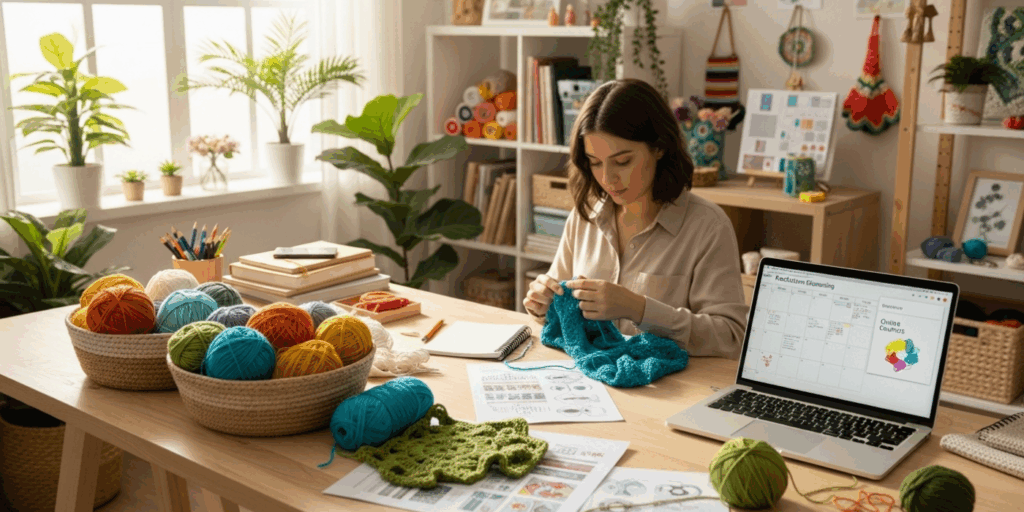
You’ve got sales. You’ve got repeat customers. But now you’re overwhelmed. You’re crocheting until 2 a.m. You’re missing family dinners. You’re tired.
This is where most handmade businesses crash.
The solution? Systemize.
You don’t need to hire a team right away. Start small:
- Batch your work. Set aside one day a week to make 5 identical hats. Then another day to package them.
- Use templates. Create a standard listing template, email template, and packaging routine.
- Outsource smartly. Hire a VA on Fiverr for $5/hour to print labels or update your Etsy shop.
- Sell patterns. Once you’ve perfected a design, turn it into a digital PDF pattern. Sell it for $5–$10. That’s pure profit—no shipping, no materials, no time spent making each one.
Patterns are your secret weapon. One crocheter, Maya, sells 200+ patterns a month. She makes $1,200/month on passive income from designs she created in a weekend.
Also, set boundaries.
Decide: “I’ll only work 15 hours a week.”
Then protect it.
Your business should serve your life—not consume it.
Remember: You’re not a machine. You’re an artist. And artists need rest.
6. The Real Profit Isn’t Just Money—It’s Freedom
Let me tell you about Maria.
She was a nurse working 60-hour weeks, exhausted, barely seeing her kids. On weekends, she crocheted to unwind. One day, she posted a crochet bunny on Facebook. A stranger offered $50 for it. Maria thought, “I could do this full-time.”
Six months later, she quit her job.
Now? She runs “Maria’s Little Creations,” teaches online crochet classes, sells patterns, and ships 30+ items a week. She works from home. She picks up her kids from school. She takes vacations in the summer.
Her income? $5,000–$7,000/month.
She didn’t become rich overnight. But she became free.
That’s the real power of turning your crochet passion into a business.
It’s not about becoming famous. It’s about designing a life you love.
You don’t need to quit your job tomorrow. Start small. Make one extra item a week. List it on Etsy. See what happens.
The first sale? It’s not about the money. It’s about the proof.
Proof that your hands, your time, your creativity—can create value.
And once you see that? You’ll never look at your yarn the same way again.
Conclusion: Your Hook Is Stronger Than You Think
You’ve learned how to find your niche, price your work with confidence, build an authentic online presence, turn buyers into believers, and scale without burning out.
But here’s what really matters: you already have everything you need to start.
You don’t need more yarn.
You don’t need a bigger house.
You don’t need to wait for “the right time.”
You just need to pick up your hook—and begin.
Maybe today, you list one item.
Maybe this week, you post your first TikTok.
Maybe next month, you send your first handmade thank-you note.
Every big business started with a single stitch.
And your passion? It’s not just a hobby. It’s a product. A service. A legacy.
So go ahead—make that blanket.
List that bunny.
Send that message.
The world doesn’t need another generic factory-made gift.
It needs your touch.
Your hands. Your heart. Your story.
What’s the first thing you’ll create and sell this week?
Drop it in the comments—I’d love to cheer you on. 💛
And if this article helped you—even just a little—please share it with a fellow crocheter. Because when one artist thrives, we all rise.
Gabriela Ferreira is a passionate crochet and knitting enthusiast who finds inspiration in every skein of yarn she touches. With a love for color, texture, and handmade detail, she brings creativity and warmth to each project she creates. Gabriela believes that every stitch tells a story, and she enjoys sharing her craft with others who appreciate the beauty of fiber arts.