Introduction
Ever finished a crochet project only to wonder, “Why doesn’t this look like the photo?” You followed the pattern, used the right hook size, and your gauge was spot-on—yet something still feels off. The fabric might be too stiff, the stitches blurry, or the whole piece starts pilling after one wash.
If this sounds familiar, the issue might not be your skill—it could be your yarn’s ply.
Ply—the number of individual strands twisted together to form a single yarn strand—is one of the most underrated factors in crochet success. While labels often highlight fiber content and weight, they rarely mention ply. Yet this hidden detail shapes everything: how your yarn feels in your hands, how clearly your stitches show, and how well your finished piece holds up over time.
In this guide, you’ll learn exactly what ply is, how single-ply and multi-ply yarns behave differently, and how to choose the right one for every project—from delicate shawls to hard-wearing market bags. No jargon, no fluff—just clear, actionable insights you can use on your very next skein.
Ready to stitch smarter? Let’s unravel the truth about yarn ply.
1. What Is Yarn Ply? The Simple Truth Behind the Twist
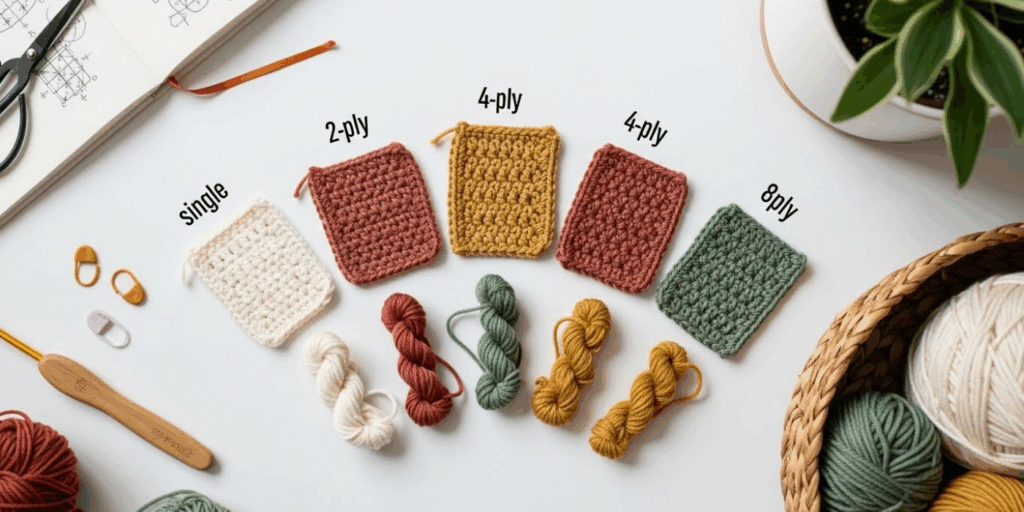
At its core, ply refers to how many individual threads—called “singles”—are twisted together to create one strand of yarn. A 2-ply yarn has two threads spun tightly around each other; a 4-ply has four, and so on. This twisting isn’t just for looks—it adds strength, elasticity, and structure.
But here’s the big misconception: ply does not equal yarn weight.
Decades ago—especially in the UK—terms like “4-ply” did signal a specific thickness (roughly fingering weight). But modern yarn manufacturing has made that outdated. Today, you can find:
- A bulky-weight yarn made from just two thick plies.
- A lace-weight yarn composed of eight ultra-fine plies.
So why should you care about ply at all? Because it directly affects your crocheting experience and your project’s longevity.
Think of it like rope-making: one thread snaps easily, but twist several together, and you get something resilient. Yarn works the same way. The number of plies—and how tightly they’re spun—determines whether your yarn will split on the hook, pill after washing, or hold textured stitches with crisp clarity.
Understanding ply helps you work with your yarn, not against it—and that’s the secret to consistently beautiful results.
2. Single-Ply Yarn: The Allure of Softness (and Its Hidden Costs)
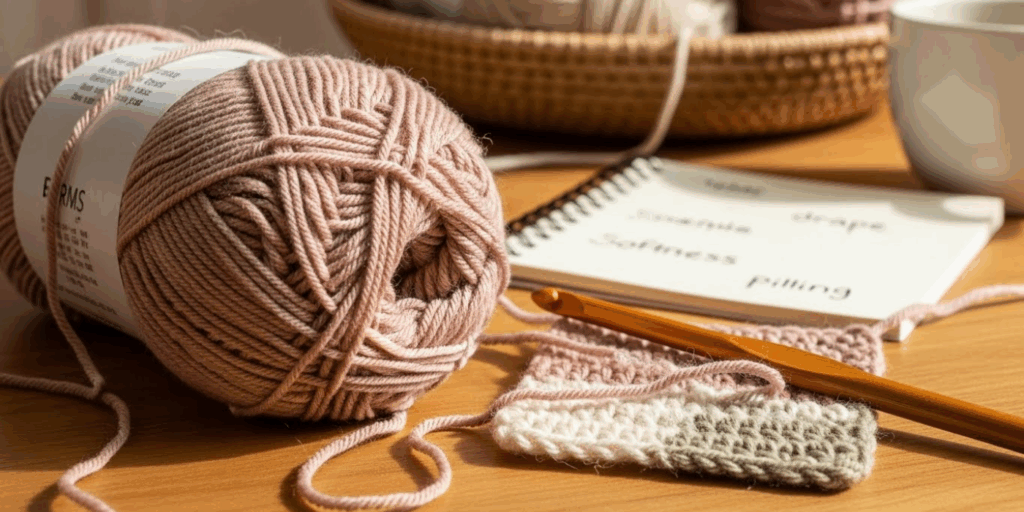
Single-ply yarn—made from one continuous strand with no additional twists from other plies—has exploded in popularity, and for good reason. It’s incredibly soft, often with a dreamy “halo” (that fuzzy glow around the yarn), and creates a fluid, elegant drape perfect for shawls, cowls, and baby blankets.
Why crocheters love it:
- Feels luxurious against the skin
- Creates a seamless, blended fabric
- Ideal for projects where coziness > structure
But there’s a trade-off: without multiple plies reinforcing the fiber, single-ply yarn is more vulnerable. It’s prone to:
- Pilling, especially in high-friction areas (like underarms or bag straps)
- Splitting on the hook if you’re not gentle
- Over-stretching or losing shape after washing
I once crocheted a stunning wrap in a single-ply merino. It felt like wearing a cloud—until it started pilling after two wears. Now, I reserve single-ply for low-stress projects where softness matters more than durability.
Practical tip: If you love single-ply, use a smooth, rounded hook (like bamboo or tulip-shaped aluminum) and avoid tight tension. A slightly larger hook size than recommended can also reduce splitting and improve stitch flow.
3. Multi-Ply Yarns: The Workhorses of the Crochet World
Most commercial yarns you see today—like Red Heart Super Saver, Lion Brand Wool-Ease, or Caron Simply Soft—are multi-ply, typically with 2, 3, 4, or more strands twisted together. This construction gives them a balanced, round profile that’s easy to work with and highly reliable.
Different ply counts offer unique benefits:
- 2-ply: Often slightly oval in cross-section, creating subtle texture. Common in sport and DK weights—great for lightweight sweaters or baby blankets.
- 3-ply: More cylindrical, leading to even, consistent stitches. Many worsted-weight yarns use this for softness and structure.
- 4-ply and higher: Offer excellent stitch definition. Ideal for amigurumi, cables, bobbles, or any project where you want every detail to pop.
Real-world example: Compare a 4-ply cotton (like Lily Sugar’n Cream) with a single-ply cotton. The 4-ply will hold its shape beautifully in a dishcloth, while the single-ply might stretch out and sag with repeated use.
Additionally, multi-ply yarns are far less likely to pill because the twist traps loose fibers. That makes them perfect for high-use items like toys, tote bags, or children’s clothing.
So when durability, stitch clarity, or structural integrity matters, multi-ply is your go-to.
4. How Ply Shapes Your Fabric: Drape, Gauge, and Wash Behavior
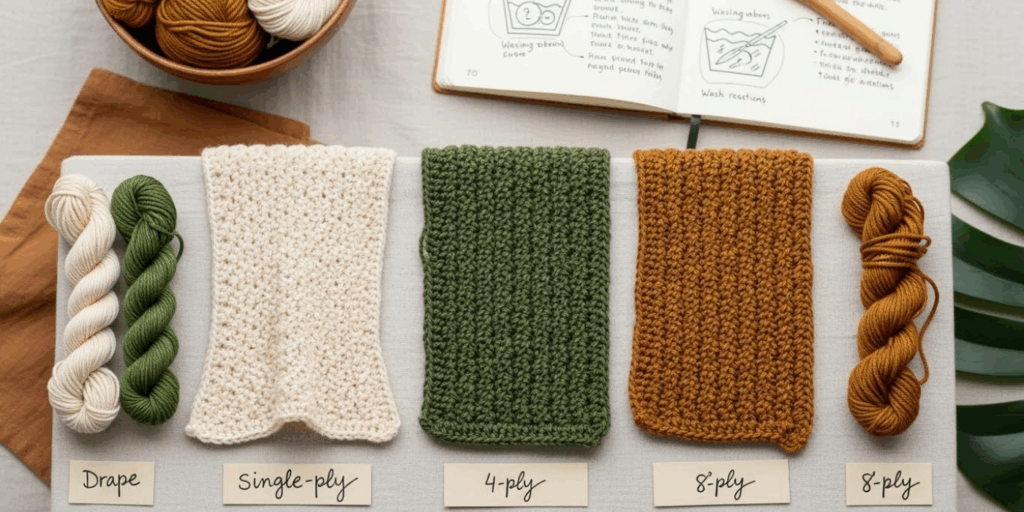
Here’s something even experienced crocheters overlook: ply can subtly shift your gauge and fabric behavior—even when two yarns share the same weight label.
Why? Multi-ply yarns are often denser and less compressible than single-ply. A 4-ply worsted yarn may produce slightly tighter, more defined stitches than a single-ply worsted of the same diameter, simply because its plies resist flattening under tension.
This impacts three critical areas:
✅ Drape
- Single-ply = soft, flowing, romantic—perfect for scarves or drapey cardigans.
- Multi-ply = structured and firm—ideal for baskets, bags, or home decor.
✅ Washability
- Tightly plied yarns hold up beautifully in the washing machine.
- Single-ply may “bloom” (soften and spread) or felt unpredictably when wet.
✅ Memory & Elasticity
- Multi-ply yarns often bounce back after stretching—essential for hats, socks, or fitted garments.
- Single-ply may stretch permanently, especially when damp.
Try this experiment: Swatch the same stitch pattern in a single-ply and a 4-ply yarn of the same weight. Wash and block both. You’ll likely see clear differences in size, texture, and hand feel. That’s ply in action.
Bottom line: Always swatch—and wash your swatch—if drape or fit matters. No label can replace real-world testing.
5. Choosing the Right Ply: A Practical Decision Guide
Still unsure which ply to pick? Ask yourself these three questions before buying yarn:
- What’s the project’s purpose?
- High-wear or functional (tote bags, dishcloths, kids’ clothes) → Choose 3+ ply.
- Decorative or low-friction (shawls, wall art, photo props) → Single-ply is safe and stunning.
- Do I need crisp stitch definition?
- Textured stitches (popcorn, bobbles, cables) → Go for 3- or 4-ply.
- Minimalist, blended look (cozy blankets) → Single- or 2-ply adds softness.
- What’s more important: softness or longevity?
- Prioritize softness? Single-ply delivers.
- Need it to last? Multi-ply wins.
Can’t find ply info on the label? Examine the yarn closely. Gently roll it between your fingers. If you can see or feel distinct strands, it’s multi-ply. If it feels like one smooth rope, it’s likely single-ply.
And remember: more plies ≠ better quality. A well-spun 2-ply can outperform a loosely twisted 6-ply. It’s about how the plies are twisted, not just how many there are.
6. Busting Common Myths About Yarn Ply
Let’s clear up a few persistent misunderstandings:
❌ Myth: “Ply tells you the yarn weight.”
✅ Truth: Ply and weight are related but not the same. Always rely on the Craft Yarn Council’s standard weight system (0–7) or the suggested hook size—not ply count.
❌ Myth: “Single-ply yarn is cheap or low quality.”
✅ Truth: Many luxury and indie-dyed yarns are intentionally single-ply to highlight fiber softness and drape. It’s an artistic choice, not a flaw.
❌ Myth: “You can’t crochet with single-ply yarn.”
✅ Truth: You absolutely can! Just use a slightly larger hook, relax your tension, and avoid aggressive hooking motions.
Understanding these nuances helps you shop with confidence—no matter what the label says.
7. Navigating Global Ply Labels: Why “4-Ply” Isn’t Universal
Here’s a major source of confusion: ply terminology varies wildly by country.
- In the UK and Australia, “4-ply” traditionally means fingering weight, and “DK” is often called “8-ply”—even though actual strand count may differ.
- In the U.S., commercial yarns rarely mention ply. Instead, they use the standard weight system (Lace = 0, Super Fine = 1, Fine = 2, Light = 3, Medium = 4, etc.).
- European yarns often list meters per 50g, which is far more reliable for comparing thickness.
What should you do?
When shopping internationally:
- Ignore “ply” as a weight indicator.
- Compare meterage per 100g (e.g., 400m/100g = fingering weight).
- Check suggested hook size—this is universal.
And always swatch. No label—no matter how detailed—can replace the wisdom of your own hands.
Conclusion
Understanding yarn ply isn’t about memorizing technical terms—it’s about learning to read your yarn like a seasoned maker. Ply shapes how your fabric drapes, how clearly your stitches show, and how well your project holds up over time. By paying attention to whether your yarn is single-ply or multi-ply, you gain creative control that goes far beyond color or fiber.
To recap:
- Single-ply = soft, drapey, dreamy—but best for low-wear items.
- Multi-ply = durable, defined, reliable—for everyday use and intricate designs.
- Ply ≠ weight, so always swatch—and wash your swatch—if fit or drape matters.
- Global labels vary, so focus on meterage and hook size when in doubt.
The next time you pick up a skein, take a moment to examine its structure. Give it a gentle tug. Notice how it feels on your hook. That small act of mindfulness can be the difference between a project that’s almost right—and one that’s exactly perfect.
Now we’d love to hear from you: What’s your favorite ply to crochet with—and what project taught you its true character? Share your story in the comments! Whether you swear by 4-ply cotton for dishcloths or live for the squish of single-ply merino, your experience helps us all stitch smarter.
Happy crocheting—and may your yarn always behave just the way you hope it will!
Gabriela Ferreira is a passionate crochet and knitting enthusiast who finds inspiration in every skein of yarn she touches. With a love for color, texture, and handmade detail, she brings creativity and warmth to each project she creates. Gabriela believes that every stitch tells a story, and she enjoys sharing her craft with others who appreciate the beauty of fiber arts.