You’ve just picked up your first crochet hook, stared at a ball of yarn, and thought: “Okay… now what?”
You’re not alone. Whether you’re crafting your first blanket, scarf, or amigurumi, one of the most confusing parts of crocheting isn’t the stitches—it’s the yarn and the hook. Why does one yarn feel thick as a rope while another is as fine as spider silk? Why does your pattern say “use a 5.5mm hook” and not “just grab whatever fits”?
The truth? Yarn weights and hook sizes aren’t just technical details—they’re the secret language of crochet. Get them right, and your project turns out beautiful, cozy, and exactly as intended. Get them wrong, and you might end up with a hat that fits a toddler… or a blanket that’s the size of a postage stamp.
In this guide, we’ll break down everything you need to know about yarn weights and hook sizes—no jargon, no overwhelm, just clear, friendly, real-life advice. We’ll explore what those numbers and labels actually mean, how to match them like a pro, why it matters for your finished piece, and what to do when you don’t have the exact yarn or hook called for. Plus, we’ll share simple tricks to avoid the most common beginner mistakes—and how to trust your eyes and hands, not just the label.
By the end, you won’t just understand yarn and hooks—you’ll feel confident choosing them, adapting patterns, and even creating your own designs. Let’s unravel the mystery—starting with the basics.
What Is Yarn Weight? (It’s Not About Actual Weight!)
When you see “worsted weight” or “sport weight” on a yarn label, you might think: “Is this yarn heavy?” Nope.
Yarn weight refers to the thickness of the strand—not how much it weighs in grams. Think of it like shoe sizes: a size 8 isn’t heavier than a size 6, it’s just wider. Same with yarn.
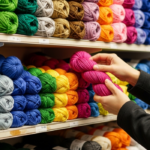
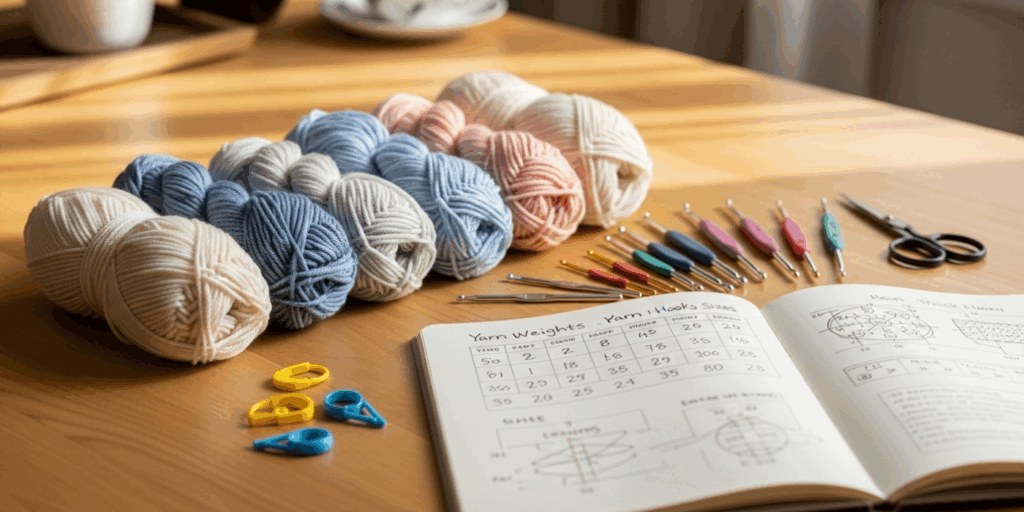
There are 8 standard yarn weight categories, from the thinnest (lace) to the thickest (jumbo). These are numbered 0 to 7, and each has a common name and typical use:
- 0 – Lace: Thread-thin. Perfect for delicate shawls or lace doilies.
- 1 – Super Fine (Fingering): Think socks, baby items. Feels light but holds up beautifully.
- 2 – Fine (Sport): Great for lightweight sweaters or children’s wear.
- 3 – Light (DK): A popular all-rounder. Soft, drapey, and easy to work with.
- 4 – Medium (Worsted): The most common weight. Used in blankets, scarves, hats—basically everything beginners start with.
- 5 – Bulky: Crochets up fast! Ideal for chunky scarves, rugs, or quick gifts.
- 6 – Super Bulky: Thick as your thumb. Perfect for cozy arm-knitted projects.
- 7 – Jumbo: Massive. Often used for large baskets, statement wall hangings, or trendy arm crochet.
Why does this matter?
If you use a bulky yarn with a tiny hook, you’ll struggle to pull it through. Use a lace yarn with a huge hook, and your stitches will look loose, sloppy, and holey. Your project won’t look like the photo—and worse, it might not even fit right!
Pro Tip: Look for the Yarn Weight Symbol on the label—a little numbered circle (like a tiny target). That’s your quick guide. If you’re shopping online and the label isn’t visible, search the yarn name + “weight chart” to find its category.
How Hook Sizes Work (And Why “mm” Matters More Than Letters)
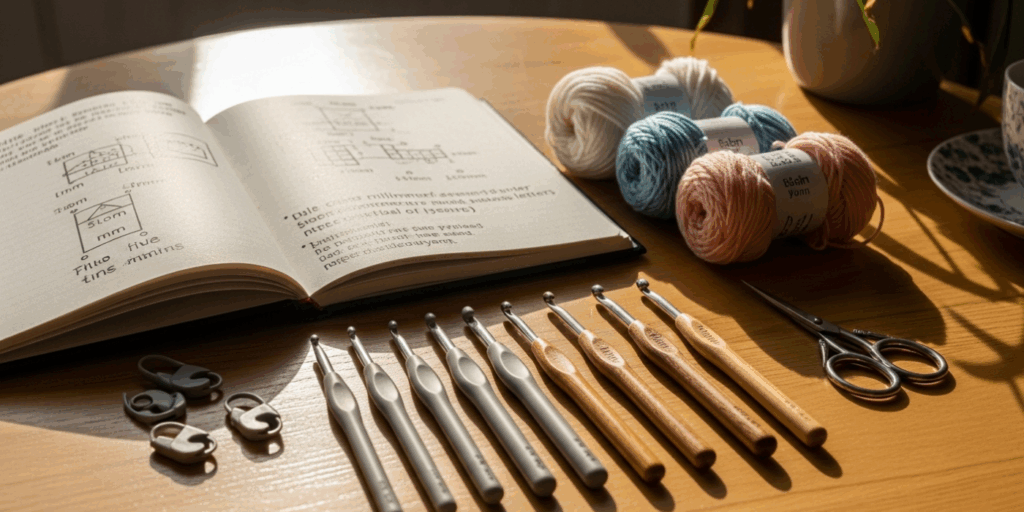
Now, let’s talk hooks. You’ve probably seen hooks labeled with letters (like “H” or “K”) and numbers (like “5.0mm” or “6.5mm”). Which one do you trust?
Always trust the millimeters (mm).
Letters (like H-8, J-10) are mostly used in the U.S., and they’re inconsistent across brands. One company’s “H” might be 5.0mm, another’s might be 5.25mm. But millimeters are universal. A 5.0mm hook is always 5.0mm—whether you’re in Texas or Tokyo.
Here’s a simple cheat sheet for common hook sizes paired with yarn weights:
| 0 – Lace | 1.5 – 2.25 mm | B-1 to C-2 |
| 1 – Fingering | 2.25 – 3.5 mm | C-2 to E-4 |
| 2 – Sport | 3.5 – 4.5 mm | E-4 to 7 |
| 3 – DK | 4.0 – 5.0 mm | G-6 to 8 |
| 4 – Worsted | 5.0 – 6.0 mm | H-8 to J-10 |
| 5 – Bulky | 6.5 – 9.0 mm | K-10.5 to M-13 |
| 6 – Super Bulky | 9.0 – 15 mm | M-13 to Q |
| 7 – Jumbo | 15 mm+ | Q and up |
Why does hook size change your project?
Think of it like this: your hook is the tool that pulls yarn into loops. A bigger hook makes bigger loops → bigger stitches → looser fabric. A smaller hook makes tighter loops → denser, stiffer fabric.
Let’s say you’re crocheting a baby blanket. If you use a 9mm hook with worsted yarn, your blanket might turn out so open and stretchy that it won’t keep your little one warm. But if you use a 3.5mm hook? You’ll spend hours on it, your fingers will ache, and the blanket will be stiff as cardboard.
The sweet spot? Match the hook to the yarn’s recommended size on the label. It’s like wearing the right shoes for a hike—you’ll be comfortable, efficient, and get the best results.
What If You Don’t Have the Exact Yarn or Hook? (The Lifesaver Trick)
Let’s be real: you won’t always have the exact yarn or hook your pattern calls for. Maybe your local craft store is out of “Lion Brand Wool-Ease,” or you found a gorgeous skein on sale—but it’s labeled “DK,” and your pattern says “worsted.”
Don’t panic. Here’s your secret weapon: the gauge swatch.
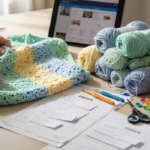
A gauge swatch is a small sample square (usually 4×4 inches) you crochet before starting your project. It tells you: “Will this combo actually make the size I need?”
Here’s how to do it:
- Using your chosen yarn and hook, chain 20 stitches.
- Crochet 20 rows in single crochet (or whatever stitch the pattern uses).
- Lay it flat without stretching.
- Measure how many stitches and rows fit in 4 inches.
Now compare it to the pattern’s gauge. For example, if the pattern says “16 stitches + 12 rows = 4 inches,” and your swatch has 14 stitches in 4 inches? Your stitches are too big. Switch to a smaller hook. If you have 18 stitches? Your stitches are too tight. Go up a hook size.
This might sound like extra work—but trust me, it saves you weeks of heartbreak. Imagine finishing a sweater… only to realize it’s two sizes too small. A 10-minute swatch prevents that disaster.
Bonus Tip: If you’re substituting yarn, try to match the weight category, not the brand. A DK yarn from Brand A is likely interchangeable with a DK from Brand B—even if the color or fiber is different.
Why Matching Yarn + Hook Creates Magic (And How to Experiment Safely)
Here’s something magical: the same pattern, with different yarn and hook combos, can create completely different vibes.
Take a simple beanie pattern.
- With bulky yarn + 9mm hook: You get a thick, cozy, slouchy beanie you can wear in winter.
- With worsted yarn + 5.5mm hook: You get a fitted, structured beanie perfect for spring.
- With fingering yarn + 3.25mm hook: You get a delicate, lacy headband—ideal for a wedding or festival.
Same pattern. Three totally different outcomes.
That’s the beauty of understanding yarn and hook relationships. You’re not just following instructions—you’re becoming a creator.
Want to experiment? Start small.
Try making a dishcloth with three different yarn/hook combos:
- One with bulky yarn and big hook (fast, chunky)
- One with worsted and medium hook (classic)
- One with sport yarn and small hook (fine, detailed)
Notice how the texture, speed, and drape change. You’ll start to feel what works. Your hands will remember. And soon, you’ll instinctively know: “This yarn needs a slightly bigger hook—I can see the stitches are too tight.”
Pro Move: Keep a little notebook. Jot down:
“Yarn: Red Heart Super Saver (worsted) + Hook: 5.5mm → 16 sc = 4 inches. Perfect for blanket.”
You’ll thank yourself later.
The Hidden Power of Fiber Content (It’s Not Just About Thickness!)
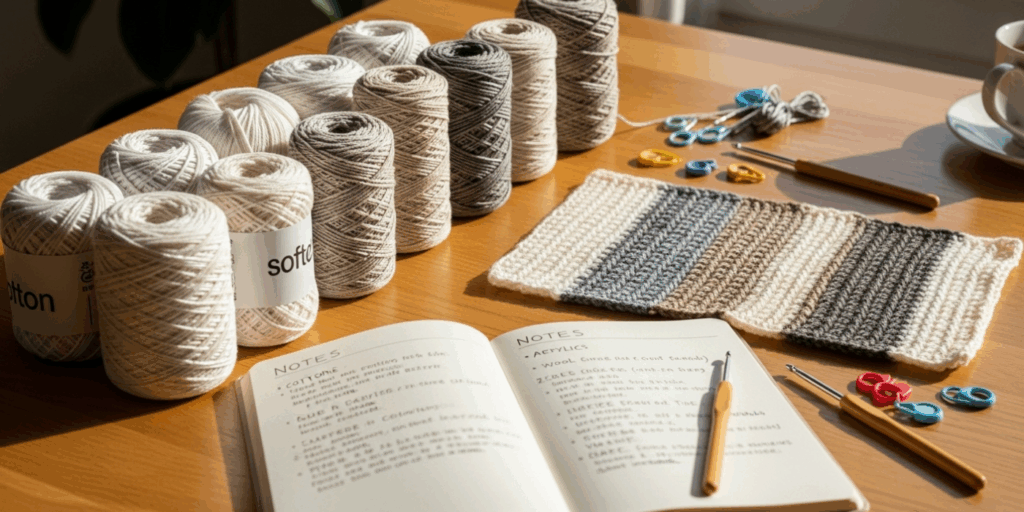
Yarn isn’t just about thickness—it’s also about what it’s made of.
Cotton, wool, acrylic, bamboo, alpaca—each fiber behaves differently. And that affects how you choose your hook.
- Cotton is dense and doesn’t stretch much. You might need a slightly larger hook than recommended to keep it from feeling stiff.
- Wool has natural elasticity. It “blooms” when washed, so your finished item might grow. Start with the recommended hook size.
- Acrylic is slippery and smooth. It can sometimes make stitches look looser than they are. If your project feels floppy, try going down a hook size.
- Alpaca or mohair are fluffy and soft. They can hide your stitches. Use a hook one size larger to make them more visible and easier to work.
Real-life example: Sarah tried making a baby blanket with super-soft alpaca yarn and a 5.0mm hook. The stitches were invisible, the blanket looked uneven, and she got frustrated. She switched to a 6.0mm hook—and suddenly, the texture popped. The blanket became a dreamy cloud of coziness.
Bottom line: Always consider fiber alongside weight and hook size. Test a swatch, wash it (if the pattern says to), and see how it behaves. That’s your true gauge.
How to Read Patterns Like a Pro (Even When They’re Vague)
You open your pattern. It says: “Use worsted weight yarn, hook size H (5.0mm).”
But what if your yarn says “medium,” and your hook is labeled “I”? What if the pattern doesn’t even mention hook size?
Here’s how to decode it:
- Look for the yarn weight symbol on the pattern’s materials list.
- Check the photo. Is the fabric tight? Loose? Chunky? That’s your clue.
- Search the designer’s website. Most give recommended hook sizes in their notes.
- Use the “swatch method”—it’s your backup plan for everything.
And if the pattern says “use any yarn you like”? That’s freedom! But still, start with the standard combo (worsted + 5.5mm) to get a feel for the stitch pattern. Then adjust.
Remember: Patterns are guides—not laws. Your hands, your yarn, your vision… they matter too.
Final Thought: Trust Your Hands, Not Just the Label
You’ve learned the science: yarn weights, hook sizes, swatches, fiber behavior. But here’s the real magic: crochet is tactile.
Sometimes, your hands will tell you something the label doesn’t. Maybe the yarn feels too stiff with the recommended hook. Maybe the stitches look uneven. That’s your intuition speaking.
The best crocheters aren’t the ones who follow rules perfectly.
They’re the ones who learn the rules, then listen to their hands.
So next time you pick up yarn, don’t just reach for the first hook. Pause. Feel the yarn. Imagine the project. Ask: “What does this yarn want to become?”
Then choose your hook—not because a chart says so, but because it feels right.
You’ve Got This. Now Go Create Something Beautiful.
Let’s recap:
✅ Yarn weight = thickness, not weight.
✅ Hook size in mm is your best friend.
✅ Always make a gauge swatch when substituting yarn.
✅ Fiber type changes how yarn behaves—adjust accordingly.
✅ Patterns are suggestions; your hands are the expert.
You don’t need to memorize every yarn category or hook size. You just need to understand the relationship between them—and how to test it.
So grab a scrap of yarn, your hook, and make a 4×4 inch swatch today. No pressure. No perfection. Just play.
And when you finish?
Take a picture.
Tag it #MyFirstSwatch.
Come back here and tell me in the comments: What yarn did you use? What hook? Did it surprise you?
Because here’s the truth: every expert crocheter started right where you are now—curious, a little confused, but willing to try.
You’re not just learning to crochet.
You’re learning to create with intention.
And that’s something no pattern can teach you.
Now… go make something wonderful.
I can’t wait to see what you create. 🧶✨
Gabriela Ferreira is a passionate crochet and knitting enthusiast who finds inspiration in every skein of yarn she touches. With a love for color, texture, and handmade detail, she brings creativity and warmth to each project she creates. Gabriela believes that every stitch tells a story, and she enjoys sharing her craft with others who appreciate the beauty of fiber arts.